


How Much Does a Waste Bill Audit Save Property Managers Each Year?
A professional waste bill audit routinely reveals meaningful operational cost reductions, though the exact amount depends on portfolio size, current contract structure, and how long billing errors have gone uncorrected. What’s consistent across properties is the mechanism: audits surface historical overcharges, align service capacity with actual site needs, and eliminate the passive fee accumulation that quietly erodes net operating income month after month.
Waste bills are one of the more reliably overlooked line items in a property’s operating budget. The contracts are dense, the invoices arrive with a tangle of surcharges and regulatory fees, and most property management teams don’t have the bandwidth, or the specialized knowledge, to audit them line by line. National haulers know this. The result is that many properties are paying for service levels calibrated to worst-case scenarios rather than actual operational reality, with ancillary fees layered on top that no one has challenged in years.
The EPA’s guide to managing waste in commercial buildings defines a waste assessment as a systematic review of a building and its operations to identify the quantity and composition of materials in its waste stream. That definition matters because it frames the audit not as a financial exercise alone, but as an operational one: you are measuring what is actually happening at the property level so you can make decisions grounded in data rather than assumptions. Tracking waste management activities through platforms like ENERGY STAR Portfolio Manager or Re-TRAC Connect gives organizations the infrastructure to benchmark performance, measure progress, track cost savings, and run reports over time. The principle is clear: you cannot manage what you do not measure. Measurement is the first step.
Core Savings Benchmarks: What Property Managers Can Expect
Understanding the exact volume and type of waste a property generates is what allows facility managers to reduce hauling costs and negotiate for services that precisely fit their physical site needs, per the EPA Commercial Waste Guide. Most commercial properties are not generating the waste volumes their current contracts assume, and they are paying accordingly. A hauler dispatching a truck to collect a half-empty container is still billing for a full pickup, and that inefficiency compounds across every service cycle of the year.
This is where right-sizing becomes the primary lever. The savings accumulate quickly. Adjusting bin sizes and pickup frequencies to match documented waste output, rather than leaving those parameters where a sales rep set them three contract cycles ago, is often where the most immediate waste bill audit savings materialize. Professional waste bill audits systematically work through this process: establishing what a property is currently generating, comparing that against what it’s currently contracted and billed for, and identifying the gap. For property managers overseeing multiple sites, that gap tends to multiply in ways that make the audit’s value self-evident.
The financial case for waste diversion strategies runs parallel to the right-sizing conversation. Increasing recycling and organic waste diversion cuts disposal costs directly, since clean recyclable and organic streams cost less to process than mixed municipal solid waste headed to a landfill. The EPA Commercial Waste Guide is explicit on this point: increasing recycling can improve an organization’s bottom line, not just its environmental profile. Think of it the way you’d think about deferred maintenance on a property: skip the diversion infrastructure, and what starts as a manageable inefficiency becomes a compounding cost problem. Connecting waste diversion strategies to financial performance reframes sustainability from a compliance obligation into a genuine line-item benefit, which matters when you’re presenting operational budgets to ownership groups or asset managers who want to see NOI move in one direction.
Common Billing Errors and Hidden Fees Draining Your Budget
Commercial waste contracts are structured in a way that makes passive overcharging almost inevitable for properties without dedicated oversight. The base service rate is rarely the problem: it is the surrounding architecture of fuel surcharges, administrative fees, environmental levies, and regulatory pass-throughs that accumulates into something significant. These charges aren’t always applied incorrectly in a fraudulent sense; many are the result of automated billing systems applying standard rate tables regardless of what a specific contract explicitly stipulates. The discrepancy between contracted rates and actual billed amounts is the gap that line-by-line auditing is designed to close. These gaps add up. Experts in the field consistently find these discrepancies in manual invoice reviews, even when the underlying service relationship appears uncomplicated. Each uncorrected billing error functions as operational leakage, a slow, invisible drain on property NOI that doesn’t trigger any alarm because no single charge is large enough to flag on its own.
The specific categories of errors and hidden fees that professional audits routinely surface include:
- Ancillary Fees and Surcharges: Unapproved administrative fees, environmental charges, and fuel surcharges applied beyond the limits established in the original contract. These often increase incrementally with each billing cycle and go unnoticed without direct comparison to contract terms.
- Overage Charges: Extra charges assessed when containers exceed agreed service limits. Properties with inconsistent tenant behavior or seasonal volume spikes are particularly exposed to these charges.EPA Municipal Collection Contract Standards
- Contamination Charges: Heavy fees applied when recyclables or compostables contain obvious contaminants. Contamination may result in added charges or require corrective sorting practices, depending on the hauler and local requirements.
- Equipment Overcharging: Billing for container sizes or service frequencies that no longer match the physical inventory on the property. This is common after tenant turnover, building renovations, or occupancy changes that were never communicated to the hauler.
- Incorrect application of local franchise fees or state-mandated environmental taxes, charges that are legitimate in principle but frequently miscalculated or double-applied in practice.
Ready to find out what your current invoices are hiding? Schedule a waste billing consultation with Copia Resources. The review is hands-off for your team: no heavy lifting from onsite staff, no disruption to operations. Just a clear picture of where your waste budget is going and what can be recovered.
The Audit Process and Waste Cost Reduction Strategies
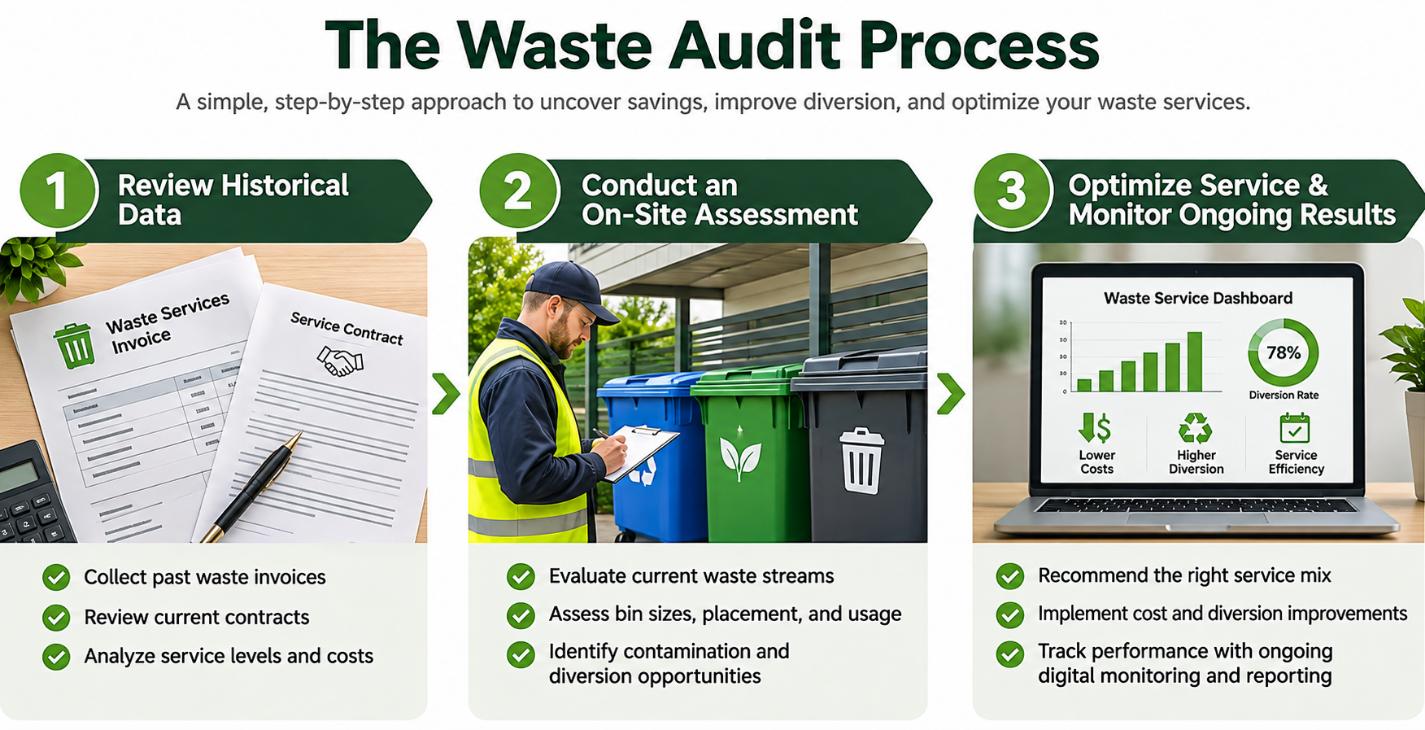
A professional waste audit begins with the paper trail. The paper trail is key. Collecting 12 to 24 months of historical waste invoices and contracts establishes the operational baseline: what the property has been paying, what service levels were contracted, and where the billing has drifted from those terms. This phase alone commonly surfaces rate increases that were applied automatically without notice or negotiation, and fee categories that weren’t present in the original agreement.
The physical waste assessment follows as a systematic on-site review of the building and its operations to identify the quantity and composition of materials in the waste stream, consistent with the EPA Commercial Waste Guide’s definition. This is where the data gets granular: actual generation rates by stream type, contamination levels in recycling bins, compactor utilization, and the physical condition and placement of waste enclosures. Some local governments and waste haulers offer free waste audits, but procurement best practices point toward utilizing independent audit services to ensure vendor-agnostic recommendations, per the EPA Transforming Waste Tool. A hauler-conducted audit has an inherent conflict of interest; an independent review doesn’t. The distinction matters when the audit’s findings will be used to renegotiate the contract with that same hauler.
A concern that comes up often in these conversations is whether reducing container sizes or pickup frequencies to achieve savings will simply expose the property to overage and contamination penalties, trading one cost for another. Professional service optimization addresses this directly by aligning capacity with documented volume rather than guessing. The CR Guarantee is Copia Resources’ operational commitment on this point: properties under active management are fully protected from overage and contamination charges. That protection removes the risk calculation from the equation entirely, which is what makes right-sizing a viable strategy rather than a gamble. Overage fees and contamination charges are real exposures, but they’re manageable ones when the service configuration is built on actual data.
The key steps in executing a waste expense reduction strategy follow a consistent sequence:
- Historical Invoice Analysis: Reviewing past bills to identify billing errors, unauthorized rate increases, and fee categories that exceed contracted limits.
- On-Site Waste Stream Analysis: Measuring actual waste generation rates by material type, identifying recycling opportunities, and documenting contamination levels that may be triggering existing penalty charges.
- Service Right-Sizing: Adjusting container sizes, compactor configurations, and pickup schedules to match the property’s documented waste output, not the hauler’s default service tier.
- Contract Renegotiation: Using audit findings as an advantage to negotiate commercial waste contracts for better rates, fee caps, and service-level flexibility.
- Ongoing Monitoring and Reporting: Tracking waste management activities in platforms like ENERGY STAR Portfolio Manager to benchmark performance, measure progress against baseline, and maintain long-term cost control (per the EPA Commercial Waste Guide).
ROI and Long-Term Value for Real Estate Portfolios
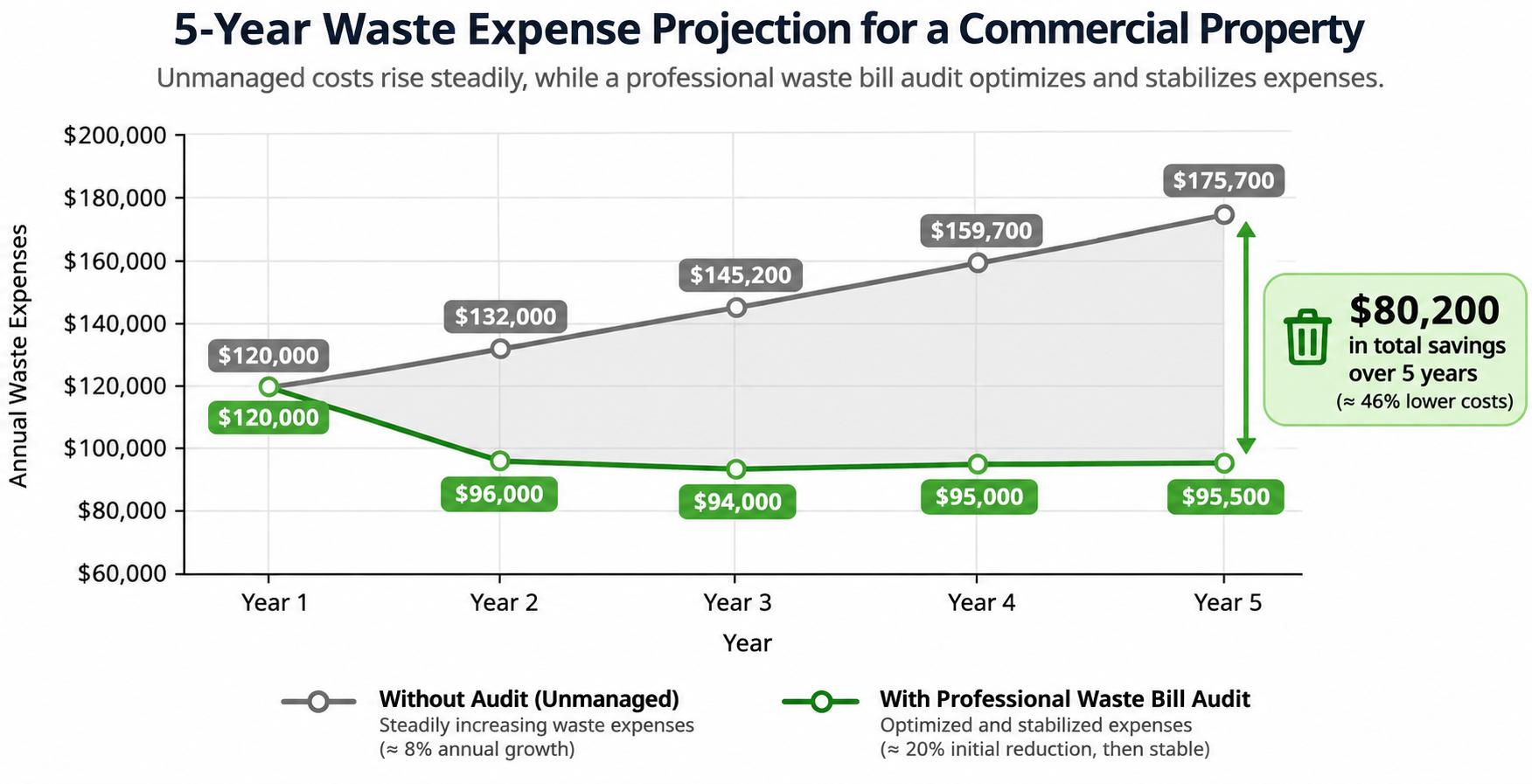
Waste cost control functions as a direct cash-flow optimization tool that improves net operating income while supporting broader sustainability goals. Every dollar recovered through corrected billing errors, right-sized services, or renegotiated contract terms flows directly into net operating income, the metric that drives property valuations, refinancing conversations, and investor reporting. For portfolio managers overseeing multiple assets, the cumulative effect of unmanaged waste expenses across a dozen properties is a material drag on performance that a systematic audit program can address. While specific dollar savings ranges vary by property type and portfolio size and aren’t something to generalize without a property-specific review, the long-term ROI extends well beyond recovered overcharges, including the avoidance of regulatory penalties that carry their own significant cost exposure.
California businesses and multifamily properties may need to follow state and local recycling and organic waste requirements. A waste audit can help property managers identify opportunities to improve sorting, document their waste practices, and plan services that support applicable requirements. Because rules vary by property and location, operators should confirm current obligations with their local waste authority.CalRecycle’s commercial recycling requirementsCalifornia recycling laws and mandates
Contract Negotiation and Service Optimization
The contract itself is where audit findings either translate into lasting savings or get absorbed back into the status quo. Contracts dictate your costs. Property managers who approach renegotiation without structured data from an audit are negotiating from a position of informational disadvantage: the hauler knows the contract terms better than they do. The specific terms worth targeting in any commercial waste contract negotiation include:
- Ancillary Fee Caps: Negotiating strict limits or complete elimination of administrative, environmental, and fuel surcharges that currently have no ceiling in the agreement.
- Service-Level Flexibility: Ensuring the contract allows for container size or pickup frequency adjustments without penalty clauses that make right-sizing economically impractical.
- Auto-Renewal Clauses: Eliminating or modifying automatic contract renewal terms to preserve long-term negotiating power rather than defaulting into another multi-year cycle at current rates.
- Contamination and Overage Fee Protection: Establishing clear, documented protocols and fair volume thresholds before haulers can assess extra charges, removing the ambiguity that makes these fees so easy to apply.
- Rate Increase Limits: Rate increase limits that cap annual hikes to a defined percentage, preventing the incremental budget inflation that makes waste expenses unpredictable over a five-year contract term.
Working with an expert partner who understands the hauler relationship from both sides changes the dynamic of these negotiations. Most property managers are generalists managing dozens of operational priorities simultaneously; waste contract negotiation is a specialty that rewards deep familiarity with hauler pricing structures, fee justifications, and the specific language that creates or closes enforcement gaps. Copia Resources operates on a model built around earning your business month after month rather than locking clients into the kind of restrictive long-term commitments that characterize the hauler relationships they’re helping to renegotiate. That approach is grounded in a decade of industry experience, ten years of working directly with commercial and multi-family properties across California and Seattle, building the operational knowledge that makes vendor-agnostic audit findings actionable rather than theoretical.
Frequently Asked Questions
How often should waste audits be done?
A waste audit should typically be conducted annually to track progress and adjust services as property occupancy or operations change. Businesses with high turnover, seasonal fluctuations, or changing operations may benefit from semi-annual reviews to prevent waste cost inflation from accumulating between full audit cycles.
Why does my waste management bill keep going up?
Waste management bills frequently increase due to rising fuel surcharges, labor costs, regulatory compliance fees, and automatic rate adjustments built into long-term hauler contracts. Properties are also often assessed extra charges based on the actual weight of waste collected or minor overages that go unnoticed without dedicated invoice tracking, small charges that compound into meaningful budget variance over a full year.
What does a waste audit precisely mean?
A waste audit is a systematic process of measuring and analyzing a facility’s waste stream. It involves physically assessing what materials are being discarded, identifying the volume of trash versus recyclables and organics, and using that data to find opportunities to reduce hauling costs, improve recycling rates, and right-size service levels to match actual operational output.
What is the cheapest way to get rid of garbage?
For most commercial properties, the most cost-effective approach is maximizing waste diversion: routing clean recyclables and organic materials into lower-cost processing streams rather than paying landfill disposal rates for everything. For smaller properties, municipal curbside pickup services remain the baseline, provided materials are properly sorted to avoid contamination fees and overage penalties that can quickly offset any savings from using a lower-cost collection tier.
What type of waste is the most expensive to dispose of?
Hazardous waste, medical waste, and electronic waste (e-waste) carry the highest disposal costs due to the specialized handling, transportation, and processing requirements mandated by environmental regulations. For standard commercial and multi-family properties, unsorted municipal solid waste, mixed trash going to a landfill, is significantly more expensive to dispose of than clean recyclable or organic streams, which is why diversion rates have a direct and measurable impact on total disposal costs.
Contact Us Today
Controlling operational overhead at the property level requires active measurement and the kind of specialized expertise that most in-house teams don’t have the bandwidth to develop. Waste contracts are complex by design, and the fees embedded in them tend to grow quietly over time without anyone challenging the underlying assumptions. Property managers don’t have to navigate hauler contracts, overage exposure, or contamination risk alone, and they shouldn’t have to become waste billing specialists to protect their NOI.
Copia Resources brings the operational depth to handle that work on your behalf. We earn your trust. To take the next step toward risk-free waste cost control, call 877-937-2750 to schedule your professional waste bill audit.